Learning Classics is a bit like putting on a magic pair of 3-D glasses. Once you start delving into the language and the culture, you'll start to see it all around you. This blog is a record of the club's journey through the worlds and language of ancient Rome and Greece... and through modern times, too, searching for the influence of classics all around us. You'll also be able to find vocab, home tasks, links and generally enlightening info here, too.
One of our favourite activities today: The Great Roman Bake Off. Using recipes from Apicius (which you can find here), we tried our hand at preparing an array of Roman dishes. First things first, we took a tour (with the odd tasting) of the ingredients available to us. Dark rye bread, apricots, figs, melon, fish sauce, honey, spices, herbs, date syrup, eggs, pepper, grape juice, raisins, pine nuts, almonds, semolina and milk - yum!
Yaren - kitchen goddess
Proud chefs!
Yaren and Jagoda impressed everyone with their focus and, quite frankly, professionalism to create a delicious semolina pudding studded with crunchy almonds and chewy raisins. The presentation wouldn't have been out of place in a five star restaurant. Therefore, quite rightly, they carried off the victor's crown.
Taiwo and Rebecca pound away
Hannah puts her back into it
The hypotrimma (a dip that seems to taste completely different depending on who's making it) required a great deal of elbow grease to get it to the right consistency. Kind of a work-out and cooking combined. Hannah and Ketsia's version was peppery and minty and absolutely delicious, and so these two won their group's title of Star Roman Baker.
"No, he's the evil chef genius!"
Adrian finds a creative way to grind pepper
Other notable dishes included mushroom patina by Kehinde and Abiye, and a fantastic ham and fig pie. The melon in mint was as wonderful as ever (if a little sweet the second time around!). We introduced a new dish this year to replace the (quite frankly, disgusting) lettuce patina: the stewed apricots were actually really delicious. Of course, we couldn't cook all this food and then not try it! A testament to the skill of all the chefs, after the judging the food was devoured by the members of Classics Club (and me!).
More on the joys of cursing today. In language work, we learned the negative imperative (i.e. how to tell someone not to do something). Using this knowledge, we created even more Latin curses (or benedictions, if we were feeling nice) ready for the next part of the lesson...
After a quick virtual tour of the Roman Baths at Bath (or Aquae Sulis as it used to be known), we looked at pictures of some defixiones (curse tablets) that were thrown into the sacred waters, and imagined what stories of deceit and treachery might be behind what was written on those little slips of metal. And then it was time to get personal. After a quick session practising backwards writing (a skill Monika never knew she had!), we started to inscribe our own curses.
Of course, being Classics Club, we had to ask some important questions about curses - mainly, do they work? What's the point of them? We discussed how, in the absence of scientific understanding, people tended to hold much more mystical views of why things happened, and also how believing that your curse would work could help you get through a difficult event in your life (like having your girlfriend stolen). Here's a golden example of how science and psychology can explain away a curse:
And don't forget that it's the Great Roman Bake Off next week. Group 1 will be staying a bit later and Group 2 need to come to the Food Tech room at 1.35pm. Yum!
First of all, we started off with a fairly fiendish language recap. Both groups did amazingly in the Millionaire Game, avoiding all the traps I set, recognising word endings (singular/plural, nominative/accusative) like TOTAL NINJAS to choose the right translation for the Latin sentence. If you want to play that game again (if only it were real money!), here's the link.
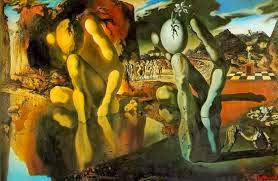
Metamorphosis of Narcissus
Next, we investigated some curses in ancient mythology: Tantalus, Narcissus and Arachne. To the right you can see an interesting interpretation of the Narcissus myth by surrealist painter Salvador Dali. Take a close look at the picture and see if you can relate any details back to the story of Narcissus. By the way, you can see this actual painting here in London at the Tate Modern.
Darnell gets mean
In language work, we took a look at imperatives - verbs that command - which are very useful for casting curses, or, if you're in a more kindly mood, giving benedictions ('bene', well/nicely + 'dictum', thing spoken). Channelling our nice or nasty sides, we assembled a few imperatives together with adverbs on paper. Next week, we'll get all authentic and etch our curses on metal to make defixiones. These were curses written on lead and thrown into a sacred well to 'activate' them. You can see some brilliant examples at the Roman Baths in Bath - but more about this when we meet next week.