Learning Classics is a bit like putting on a magic pair of 3-D glasses. Once you start delving into the language and the culture, you'll start to see it all around you. This blog is a record of the club's journey through the worlds and language of ancient Rome and Greece... and through modern times, too, searching for the influence of classics all around us. You'll also be able to find vocab, home tasks, links and generally enlightening info here, too.

17 July 2017

Lessons 20 & 21 - Caecilius et al.

These last two lessons, we've taken a slight departure from our usual lessons. We're close to the end of term and our time together in Classics Club 😢 so we're thinking a bit about next year. Time to meet these guys...
omnes sunt in atrio!
Say hello to Caecilius, Metella, Quintus, Clemens, Grumio and the mighty Cerberus - characters from the Cambridge Latin Course. If you carry on with Latin in Y8, you'll find out all about their lives and (spoiler alert!) deaths in the Roman city of Pompeii.


quid facit canis?

If you're interested, you can visit https://www.clc.cambridgescp.com/books/book-i. Have a great summer!


16 June 2017

Lessons 18 & 19 - Good gods!

A slightly dysfunctional bunch
You can't study Classics without at some point coming up against the Greek and Roman gods. They seem to get involved everywhere in human stories, both ancient and modern. So, after a quick game of Name That Deity (bonus points for getting both Greek and Roman names), we had a go at filling in their family tree.

Devon's epic Gods research
Actually, we concentrated mainly on the Olympians (highlighted in green on the family tree, and named after their home on Mount Olympus), but we also explored the Titans (the generation before the Olympians). Devon astounded us with his knowledge of the Titanomachy ('Titan battle'), where Zeus and his brothers overthrew the previous generation. But hold up a minute, don't we know that sometimes myths tell us something about the world around us, including human nature? So a myth that talks about a younger generation getting angry with the older members of their family... perhaps this is one way the Ancient Greeks recorded and explained the natural phenomenon of teenagers rebelling against their parents. I mean, if Zeus got mad at his tyrannical father, isn't it normal that adolescent humans do, too? Mind you, from the evidence of this video, I wouldn't want to take on Kronos (I think I'd just get on with my homework/chores):


26 May 2017

Lessons 16 & 17 - Unmythable

Moving on from democracy (and psychology!), over the last two weeks we've been looking at another thing for which the Ancient Greeks are rightly famous:


Cyclops - some serious image rehabilitation
We kicked off with a quiz, identifying Ancient Greek mythological characters and their modern-day descendants. Then, always keeping an eye on the modern as well as the ancient, we investigated why these intriguing and often scary tales play such an important part in so many cultures. 

We all agreed on Mormo and Father Christmas as tales used to keep naughty children in check. There was also consensus on mermaids and the Taraxippi as myths that helped explain natural phenomena. However, the debate got very lively when it came onto the origins of UFO stories. Some of us bought into the fact that these stories tap into human physiology (sleep paralysis) and psychology (addressing our deepest fears), and perhaps even controlling the masses, but others argued that they weren't myths at all, but true accounts of actual events. 

Always listen to your dad!
In language work, we continued our mythological theme, looking at the 'Metmorphoses', Greek myths written down in poems by the Latin writer Ovid. Specifically, we looked at the myth of Icarus (which you already knew in such detail - awesome!). We played a game of Word Roots Challenge using a section of the poem, and then we translated a simplified Latin version of the myth.

And, as promised, if any of you want to re-watch that clip of Odysseus (a.k.a. Nobody) outwitting Polyphemus the Cyclops, here you go:


14 May 2017

Lesson 15: All too human

After a little bit of Latin language work (quick fire verbs, noun endings), we picked up on the serious business of Plato's idea that most humans are not fit for deciding their own government (i.e. democracy). Surely some mistake?

After listening (again!) to the excellent Ken Taylor (see last' week's entry), we considered the ways in which regular people are not always straight-thinking, rational beings. We dug deep into the Card Experiment (thank you, Isaac, for a wonderfully clear explanation!), which shows us that the human mind tends to look for confirmation of what it already believes to be true ('confirmation bias'). "So what?!" you may think. "What does a bunch of cards have to do with how people vote? Well, we then discussed the issue of fake news, and how people tend to look for stories that confirm, rather than challenge, their political beliefs.


We then took a quiz that illustrated some of the other human biases discovered by psychological research: attribution bias (when I do well, it's because I'm awesome, but if I don't it's because my external circumstances were to blame), overconfidence bias (I overestimate my ability to get things right), ingroup bias (favouring people in my group) and primacy/recency bias (remembering the first and last things you heard/saw, but not so much the bit in the middle). If you're interested, you can read more here.

So, bringing it all back to Plato, Ken Taylor ends on a note of optimism. Humans may be biased, but hey, at least we now know it. Maybe now we can try not to be like this and democracy will be a better system. What do you think?...

08 May 2017

Lesson 14 - Encountering the irrational

Half this lesson was devoted to translating Latin sentences (no warm-ups, straight in at the deep end).
Using vocab lists and tables to help with our sentence translations...

Each sentence started out with a verb, then added one or two nouns. The class had to 'squeeze' as much information as possible (who? what? when?) out of the verb, then decide whether the nouns were subject or object, singular or plural.


After that, time to philosophise... We've been thinking over the last few weeks about the best ways to govern a country (topical!), and it's safe to say that we all accept Plato's point that democracy's a less-than-perfect system: people don't always think straight when choosing their leaders.

But can we do anything to help this situation? We listened to Ken Taylor, who thinks we can:
Now, there are some complicated ideas in here (it's a TED talk, after all!), but the main thing that Ken Taylor is saying is that:

  • yes, humans make mistakes

but!
  • modern science (psychology) helps us to understand these mistakes ('cognitive biases')

and
  • if we understand them, we are less likely to let them affect our thinking

so
  • we all need to become better philosophers (or psychologists, which boils down to the same thing for him - it's all about gaining and using wisdom).

 Next week, we'll have a fun look at some of the unexpected and biased ways your brain makes decisions.

01 May 2017

Lesson 13: Language recap

A session of language work this week, recapping everything we know about Latin nouns and verbs. 

After recapping this information, and warming our brains up by looking at how to squeeze verbs for as much 'who, when and what' as possible, we went on to translate some sentences, all containing the words 'regina' ('queen'), 'gladius' ('sword') and 'habere' ('to have').
Such tiny differences on the ends of words can make such a difference to the meaning of the sentence, as we discovered.

We finished the lesson with a recap - ahead of next week - of Plato's ranking of forms of government, with democracy pretty low down. Do you really believe, as Plato did, that people make stupid decisions when electing their leaders? If so, is there any way we can improve the ways that people make decisions? We'll find out next week...

24 April 2017

Lesson 12: How to rule

We warmed up this week by looking at some words and ideas important to Aristotle, and by thinking of English words that come from those words. 


Next, we moved on (or perhaps backwards!) from Aristotle to his teacher Plato, who had some very interesting thoughts about the best ways for society to organise itself. First of all, we matched up various ‘-archy’ (‘rule’) and ‘-cracy’ (‘power’) words to their definitions. 
Timocracy - rule by people called Tim?
Democrat? Plutocrat? Oligarch?

Plato had some very clear thoughts on which systems of rule were better than others, but pretty low down on his list was democracy (behind aristocracy, timocracy and plutocracy). 

Say what?!! Isn’t democracy what we all aspire to?!!

But, perhaps with recent elections and referenda in their minds, several of the class came up with exactly the argument that the great Plato makes: “Some people don’t know what they’re on about and make the wrong decisions.” (Talk about great minds thinking alike!)


Next week, we’ll explore some of the ways in which voters can be biased, and work out whether modern society has the answers.

24 March 2017

Lesson 10: Food for thought... and for eating

"Please don't tell me my existence is meaningless!"
After a quick entree of Latin verbs, we got down to more important matters i.e. solving the mysteries of the universe (with a little help from Aristotle). Recalling our previous lesson (how we use memory and experience to make sense of the world), we explored how Aristotle disagreed with his teacher Plato about how we perceive reality. In Aristotle's world, it's all about experience, and not about some mystical, pre-existing 'ideas' or 'forms'. "Ask questions!" Aristotle urges us. "Ask what things are made of! Ask how they got here! And most importantly, ask WHY they exist!" Cue an epic class debate on the nature of the universe (which Devon has 100% figured out, apparently, but which the rest of us are still struggling with). Anyhow, your "What's The Point Of Flies And Spaghetti Bolognese?" worksheets should make for some interesting dinner conversations this weekend...

Enough of food for thought, let's have some real food for eating. We started the second
Sorry, Romans, not for you
half of our lesson with a quiz to see just what a Roman might have had in his or her kitchen cupboard. No jacket potatoes, popcorn or ketchup for these guys, as all these ingredients were native to South America, a land unknown to the Romans. No sugar either. They had to sweeten their food with fruit juices, fruit syrups and honey. Which we then tasted, along with authentic Roman bread (not to everyone's taste, but Daniel couldn't get enough!), pomegranate, dates and a fresh cheese. On the way out of the lesson, more dates and a recipe sheet of authentic Roman recipes translated from the original Latin of Apicius. Enjoy!


03 March 2017

Lesson 9: Bants!

Lego actually means 'I read' in Latin!
Bants about the imperfect
We're back (finally!) after half-term and INSET, starting with a quick game of Wood Roots Challenge (score = 18), and refreshing our memories about Latin verbs. With boards and markers, we played Quick Fire Verbs, looking at the beginning of the verb to see what is happening, and the end to see who is doing it. If you ever liked Lego (I still do!), you'll love Latin. The two are really similar: just use different 'bricks' (word stems, word endings) to change grammatical information (e.g.person, number, subject/object). Today we learned about a new set of 'bricks' - endings that show the imperfect (the Tense Formerly Known As Past Continuous Or Past Progressive), which translates as 'was .....ing'. 'Imperfectus' in Latin actually means 'incomplete', giving you an idea of the action of the verb being ongoing rather than done and dusted. So, after a verbal run-through of the endings, we played a game of Imperfect Quick Fire Verbs before settling down to an exercise sorting and translating verbs in this tense.

Elephant? Sofa? Sofa made out of an elephant?
Next, a brain-break... or was it? In a visual quiz, we looked at close-ups of objects and tried to work out what the object was. Fun, sure, but what on earth did this have to do with Classics (an excellent question asked by one of the class!)? Well, in working out whether that blue scaly stuff was from a snake, a dragon or a shoe, and in assessing if the brown wrinkly material was a leather sofa or an elephant, we all had to do the same thing: go back into our memories and search through our life experiences. Next week, we'll look at how the Ancient Greek philosopher Aristotle came up with the idea (radical for its time) that all of our knowledge is based on experience.

09 February 2017

Lesson 8 - Number time

Today we looked at numbers in Latin and in Ancient Greek, and discovered that they're still all around us in the modern world. Firstly, Latin, where we played a game of Word Roots Challenge, trying to find as many English words that come from...
This then led to several of the students asking, puzzedly, "If 'octo' means eight, then why isn't October the eighth month?" Two reasons for the confusion: (1) Romans started their year in March, and (2) these guys inserted their not-immodest egos into our calendars and got rid of the names for months 5 (Quintilis) and 6 (Sextilis).
Julius Caesar (July)

Augustus aka Octavian (August)
For more details behind the months' names, click here. We then turned our attention to Ancient Greek numbers. This time, working in reverse, we used English words as clues to help us work out Greek numerals:


This then led to another discussion about words ending '-athlon' (e.g. triathlon, pentathlon, decathlon): 'athlon' means 'competition' or 'contest' in Ancient Greek, so the number before it denotes how many competitions, or events, there are.

02 February 2017

Lesson 7 - Putting it all together

Today we focused just on our Latin language work, drawing together all of the things we've learned since starting in October.

We know about nouns....


We know about verbs...


We know some vocabulary...


So now, we put them all together, to work with sentences. But remember the number one rule in translating Latin sentences: find the verb (usually at the end), see who is doing the action by looking at the ending, then see what is happening by looking at the rest of the verb. By the end of the lesson, we were happily translating sentences that were four words long.

17 January 2017

Lesson 6 - Dinosaur discoveries

ich bin ein Ohrwurm!
Quite a lot packed into our session today. We warmed up with a game of Quick Fire Verbs: look at the beginning of the verb to see what's happening and the end to see who's doing it. The class has got impressively quick at this - looks like the o-s-t chant has done its job of giving you an earworm! (For more information on earworms - also known as brainworms - have a look here: https://en.wikipedia.org/wiki/Earworm).

After going through our verbs worksheet, we then talked
about dinosaurs. But this is Classics Club, right? What have dinosaurs got to do with anything? Well, you knew that the word 'dinosaur' meant 'terrible lizard'. We then discovered that this comes from the Ancient Greek 'deinos', meaning 'terrible' and 'sauros', meaning 'lizard'. Many dinosaur names are compounds with their parts coming from Ancient Greek (and the odd bit of Latin). 'Tyrannosaurus rex' means 'king-lizard-king', just in case there was any doubt that he's at the top of the food chain. 'Velociraptor' means 'speedy thief'. And my personal favourite, the brontosaurus, or 'thunder lizard'. We then had a go at synthesising (putting together) compounds to create new dinosaurs. There were some pretty terrifying creatures, with more than two compound parts in many cases! 


09 January 2017

Lesson 5 - verbs, verbs, verbs

Into 2017 with a gear change of time (Monday lunchtime), venue (AG04) and focus of study (verbs). After making extra sure we know exactly what makes a verb a verb ('doing' or 'being'), we took a look at how Latin verbs show you not only what is happening, but who is doing it. Next week, we'll take a look at those verbs in sentences.

What + who = Latin verb


We then took a look at the six present tense endings that tell you who is doing a verb:

Using this verb ending 'code', we then 'cracked' some Latin verbs:

Next week, we'll take a look at those verbs in sentences.

03 December 2016

Lesson 4 - Stars in our eyes

Following the fascination we had last week in all things to do with stars, we had a special session today on celestial bodies and their links to both ancient mythology and modern science and belief.  


First of all, though, we tackled our language work, decoding the endings of Latin nouns to find out whether the noun was a subject (nominative) or an object (accusative). We then had a go at changing Latin words to show who was doing the action in a sentence, and who or what was having the action done to it.


Then onto things starry, and the VERY IMPORTANT distinction between astronomy (the branch of science which deals with celestial objects and space) and astrology (the study of the movements of stars and planets interpreted as having an influence on humans). Both contain the root 'astro-', which is Ancient Greek for 'star', but the class went on to discuss what the difference is between science and belief. Do you believe that all people born under the sign of Taurus are stubborn? Are all Virgos perfectionists? 

No matter what you believe, there are some amazing myths behind the constellations we can see in the night sky.
If you go to https://www.wwu.edu/skywise/greekmyth.html you can also see an extensive list of the myths of constellations. 

26 November 2016

Lesson 3 - Categories, scientific and grammatical

lots of derivatives
We warmed up at the start of the lesson with one of my favourite games, Word Roots Challenge. As Latin words (and their English meanings) appeared on the board, we all tried to think of as many modern words (English or any other European language) that have descended from these Latin 'root words'. There was no shortage of excellent answers, as you can see from the picture on the left. And, thanks to the amazing linguistic talents of Classics Club students, I now know the word for 'pig' in both Spanish (puerco) and Portuguese (porco, so very similar to its Latin root, porcus).

Next, we considered last week's challenge, and recalled how
felis domesticus (aw, bless!)
sorting things into categories can be very complicated. We then looked at how the eighteenth-century scientist Charles Linnaeus came up with a seven-part system for categorising everything that can be found in nature. We also saw how that system is still in use today, and how these category names are in Latin (and sometimes ancient Greek) as this was the shared language of European scientists in the eighteenth and nineteenth centuries. Then, using our powers of deduction, we matched some Latin scientific names up with various pictures.


Latin x exercise = Laxercise ?!
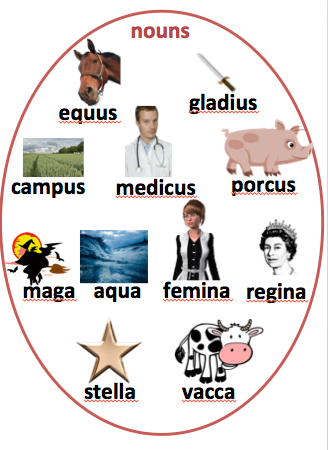
We then turned our that very important type of word, the noun. We played 'If It's A Noun, Sit Down', a game that cunningly blends grammar learning and physical exercise. The game initiated some fantastic critical conversation amongst the students. Is maths really a thing? What part of speech is 'yesterday'? You can't touch bravery, so can it be a noun? Learning Latin will make you a grammar ninja, guaranteed! So once we had established that we could all spot a noun at twenty paces, we then looked at how Latin changes word endings to show whether a noun is doing the action in a sentence (the subject), or whether it is having the verb done to it (the object). 

Tum nobis cenandum erat! (And then it was lunchtime!)

19 November 2016

Lesson 2 - everywhere you turn... Latin!


Latin in your pocket
Our mission in Classics Club today? To realise just how much Latin we already know. We're surrounded by Classical influence, from the coins in our pocket to the words that we speak. We emptied out our pockets in search of a particular kind of pound coin, one that read around its rim:

DECUS ET TUTAMEN

We found several! This inscription means 'beauty and security' (i.e. what money is supposed to be). And what language is this in? Latin! We weren't lucky enough to find:

NEMO ME IMPUNE LACESSIT (nobody may provoke me and get away with it - motto of the kings of Scotland)... also Latin.
Language evolves...

We did, though, find the Welsh pound coin which Devon bravely read out loud:

PLEIDIOL WYF I'M GWLAD (I am faithful to my country)

We then moved on to an exploration of the English language, to show just how much Latin we already know in the form of modern words that have their roots in the ancient language. Students flew through the task of matching familiar English words to their etymological ancestors. 

We also explored the notion of language as an organic entity that is constantly changing, from the transition of Latin into French, and then the imposition by the Normans of their language on the English from 1066 A.D. onwards. And, of course, more l8ly, the impact of technology changing language 4eva.

Making a bold start in our Latin language work, learning the first and most important rule of Latin: it's not the word order that's important, but the word ending. Then, using this rule, and looking at two model Latin sentences, the class showed its amazing code-cracking skills to work out that 'a' shows that a noun is the subject of a sentence, and that 'am' shows that a noun is the object.

Mus musculus

Finally, we turned our attention to another way in which Latin lives on in modern times: scientific categorisation. We just about had time to have a go ourselves at sorting a diverse bunch of objects/creatures/plants into categories, just to prove to ourselves how hard a job it is (How do we group the objects? Size? Colour? Function? Intelligence?). Next week we'll have a look at how Carl Linnaeus tackled this problem, with the help of Latin and Ancient Greek, to create a scientific naming system that is still in use today.

13 November 2016

Lesson 1 - Here we go again!

A new term and a new crop of budding Classicists at Greig City eager to learn about the influence of Ancient Greece and Rome in our modern world.

We spent the first lesson taking a trip back in time, past the Victorians, past the Elizabethans, way, way back to the point where A.D. becomes B.C. On the way, we registered the fact that A.D. stands not for 'after death' but for anno domini, which means 'in the year of our Lord' in... Latin! We discovered how language is a living, breathing tool that develops and changes over time, which spreads across countries with conquests and learning. Most importantly, we found out how English is a mixture of words from two sets of invaders: the Vikings and Nordic raiders, who gave us Anglo-Saxon, and the Normans who brought the French language, which in turn was descended from Latin.

We also had our first look at the Ancient Greek alphabet (this word actually comes from its first two letters, alpha and beta). Then the class made wonderful name badges in Greek, so well done to Αρνϖ, Σεθ, Μαρια, Δανιελ, Κεϕιν, Στεϕαν and Δαϕιδ!

04 July 2016

Lesson 26 - Testing times

A very quiet lesson today: the end of year test. Whatever your score, top marks for the quality of your chicken representations.


26 June 2016

Museum of London trip

Only Max managed to identify this as a horseshoe
Last Friday saw us leave school behind and spend an amazing day at the Museum of London, experiencing life in Roman Britain.

A strigil, for scraping oily backs

First stop was an object handling session, where we played historical detective to work out the uses of the objects we were given. Some were easier than others. Mystery objects turned out to be an amphora, a roof tile (with an accidental pawprint), a glass makeup bottle and spatula, a brick from a hypocaust system, a key for a lock, and a strigil. A quick dress-up session followed, where the workshop leader made Jamellia up as a noble lady, complete with stola (dress), palla (cloak) and fibula (brooch). Adrian was transformed into a Roman soldier, with metal armour and helmet.

Then on to our next session, a dramatic retelling of the story of Boudicca and her revolt against the Romans. The storyteller left out absolutely none of the gory details, telling us all the nasty, certificate-18 behaviour of both Romans and Britons alike. Once we'd contemplated this outrageous behaviour, we divided into groups of Romans and Britons, each group tasked with giving a rousing pre-battle speech before the forces of Gaius Suetonius Paulinus clashed with the baying Britons, led by Boudicca. And look what I found on YouTube - not quite as good as you lot, though ;-)


Then, lunch and some free time to explore the museum. One quick photo opportunity taken, we then marched back along London Wall (guess why the road has this name?!) to Moorgate station and our homebound train.

dicite 'caseum' omnes!

20 June 2016

Lesson 25 - All together now

Since this was our last lesson before out end-of-year test, we spent the majority of it revising the language work we'd covered this year. And here it is:
Click to enlarge
Work on your revision sheets demonstrated that your grasp of the language is getting better and better...
Shantay

Abiye

Rebecca
So, the following weeks look like this:

Friday 24th June (all day): trip to Museum of London
Friday 1st July: end-of-year test
Friday 8th July: INSET day, no school
Friday 15th July: Y9 taster Cambridge Latin Course lesson